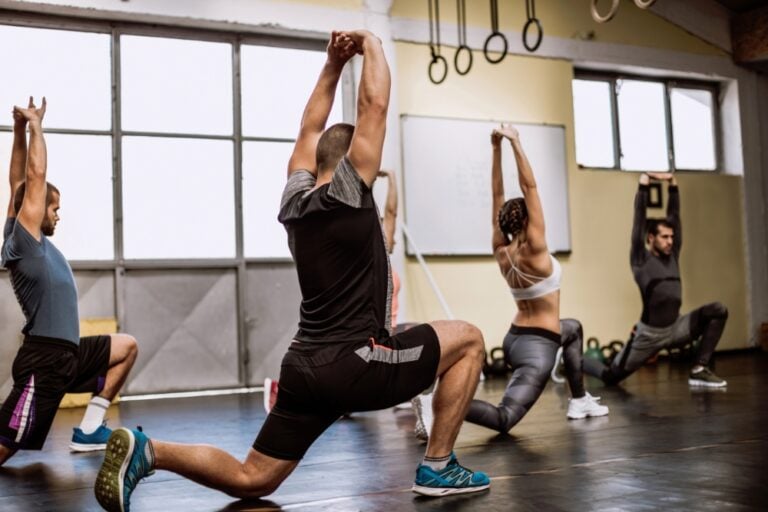

Many people skip training due to lack of time. Circuit training removes this barrier. It offers a simple, efficient structure where you complete several exercises back-to-back, targeting different muscle groups.
Each session can be completed in 20–30 minutes. This suits people with busy work hours, school routines, or family schedules. Circuits do not require large spaces or special equipment, making them useful at home, outdoors, or in a gym.
This article includes a list of 10 exercises, along with a sample structure. Each movement lasts 30–60 seconds and is suited to any fitness level. The format improves strength, cardio performance, and mobility.
What Is Circuit Training
Circuit training is a workout format where a set of exercises is completed in sequence with minimal rest between each one. The exercises target different muscle groups or physical qualities such as strength, endurance, and mobility. The structure allows for full-body training in a short period.
Each exercise in a circuit is performed for a set time or a specific number of reps. After completing all exercises, the full sequence is repeated for multiple rounds. Circuit sessions typically last between 20 and 40 minutes including warm-up and cooldown.
This method suits people with limited time or those looking to maintain general fitness. It can be done using bodyweight only or with small equipment like dumbbells, resistance bands, or kettlebells. Circuits can be modified to match fitness level by adjusting pace, load, or rest time.
Circuit training is commonly used in home workouts, group sessions, and athletic programs. It supports muscle conditioning, cardiovascular output, and calorie use without requiring isolated routines.
How Circuit Training Works
Circuit training involves a set of exercises completed one after another with minimal rest. This structure increases output while reducing time spent in the gym.
Benefits include:
- High energy use in short sessions
- Full-body activation in every round
- Flexibility to scale difficulty
- Can be done with bodyweight only
The format improves both cardiovascular output and muscular endurance. It is suitable for beginners and experienced users with time constraints.

Exercise List for Time-Efficient Circuits
Each movement in this list targets different parts of the body and supports full-body development. Exercises are suitable for short, high-effort sessions and can be adjusted for different levels.
1. Jumping Jacks
Stand upright with feet together and arms at your sides. Jump while spreading your legs and raising your arms overhead. Return to the start and repeat at a steady pace. Keep knees soft on landing and avoid swinging the arms loosely.
Benefits
- Raises heart rate before resistance exercises
- Activates full-body coordination
- Prepares joints for movement
2. Push-Ups
Start in a plank with hands shoulder-width apart. Lower your body until your chest nears the floor, then push back to the top. Keep your spine neutral and hips level. Beginners can use a knee variation.
Benefits
- Strengthens chest, triceps, and shoulders
- Supports shoulder joint control
- Builds upper body endurance
3. Bodyweight Squats
Stand with feet shoulder-width apart. Lower your hips while keeping heels grounded. Keep your chest upright and knees over toes. Return to standing by pressing through your heels.
Benefits
- Targets glutes, quads, and hamstrings
- Improves mobility and joint control
- Builds lower body strength without load
4. Plank Hold
Position forearms on the floor and extend legs straight. Keep hips steady and body aligned from shoulders to heels. Avoid sagging or arching. Focus on controlled breathing.
Benefits
- Improves core muscle activation
- Builds postural control
- Reduces lower back strain in other lifts
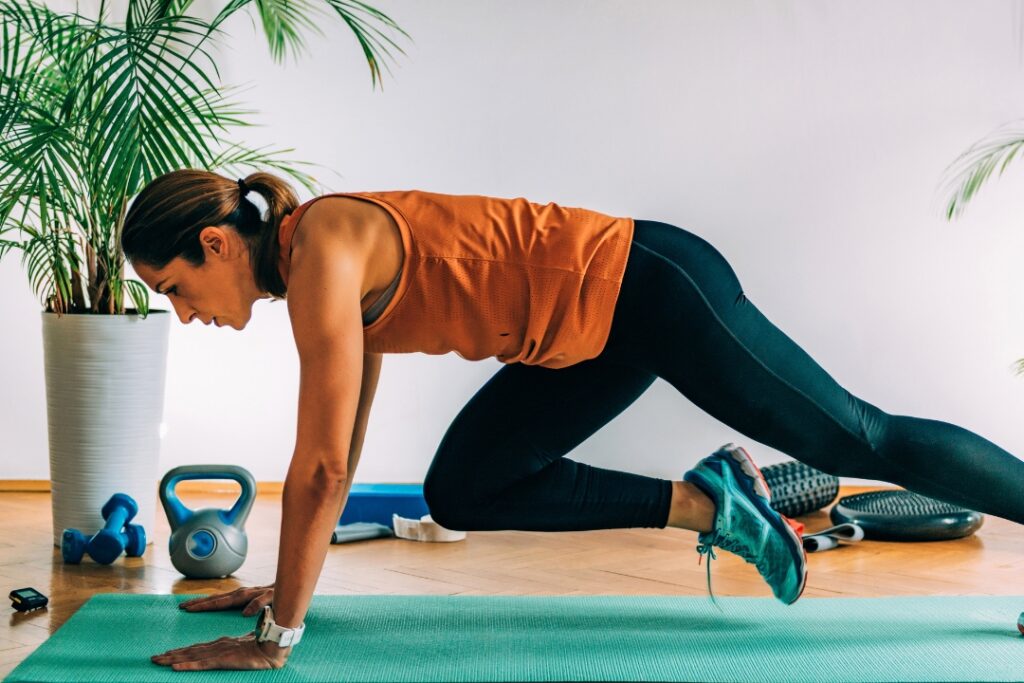
5. Mountain Climbers
Start on a high plank. Drive one knee to your chest, then switch legs at a fast but stable pace. Keep shoulders above hands and avoid hip rotation.
Benefits
- Trains core under dynamic movement
- Elevates heart rate quickly
- Strengthens hip flexors and shoulders
6. Dumbbell Rows
Hold a dumbbell in one hand. Support the opposite arm and leg on a bench or chair. Pull the weight toward your torso with a steady elbow movement. Switch sides after the set.
Benefits
- Strengthens upper back and arms
- Improves scapular movement control
- Supports posture in compound lifts
7. High Knees
Run in place by lifting knees toward your waist. Use arm movement to assist balance. Keep your body upright and land softly with each step.
Benefits
- Increases heart rate for cardio output
- Activates lower abdominal muscles
- Builds rhythm and foot control
8. Lunges
Step one leg forward and lower both knees to 90 degrees. Return to the start and repeat with the other leg. Keep your torso upright and knees aligned.
Benefits
- Trains single-leg strength and balance
- Strengthens glutes and hamstrings
- Improves control in lower body movement
9. Bicycle Crunches
Lie on your back. Bring one knee toward your chest while rotating the opposite elbow to meet it. Alternate legs and keep motion smooth. Avoid pulling the head forward.
Benefits
- Trains obliques and abdominal muscles
- Enhances rotational core control
- Increases midsection endurance
10. Burpees
From standing, squat and place your hands down. Jump your feet back to plank, return them forward, and stand or jump up. Repeat with steady form.
Benefits
- Engages major muscle groups in one movement
- Combines cardio and strength effort
- Useful for high-effort conditioning work
Sample Circuit Setup
To use the exercises effectively, follow a clear time-based structure. The example below works for most users without modifications.
Basic circuit setup:
- 3min warm-up
- Work each exercise for the listed time
- 30sec rest between each exercise
- 2–3 rounds depending on available time
- 3min cool down
Progress can be tracked by reducing rest or increasing rounds gradually.
Use Circuit Training at Active Fitness Medowie
Circuit formats are used in many of our group sessions at Active Fitness Medowie. Our programs are structured around short time blocks using movement combinations that train strength, balance, and control.
Each session is planned to fit local member schedules. Circuits are designed to be done in under 40 minutes, including warm-up and recovery periods. Modifications are available during class for all fitness levels.
Visit our gym to join circuit classes or speak with our trainers for exercise guidance suited to your routine. Timetables are built to work around work, school, or weekend schedules.
FAQs
Can circuit workouts replace traditional gym sessions?
Yes. When planned correctly, circuits provide both strength and cardio benefits in less time.
Do I need equipment for these exercises?
No. Most movements listed use bodyweight only. Small items like dumbbells or bottles are optional.
How often should I complete a circuit workout?
2–4 sessions per week works for most people. Rest days should be included between high-effort rounds.
Are circuit workouts suitable for beginners?
Yes. Exercises can be adjusted for pace, duration, or form based on ability.
What’s the ideal duration for a full circuit?
A full session, including warm-up and cool down, can take 25–35 minutes.