
You’ve done Active Pump on Monday, boxing on Wednesday, and by Thursday your legs are talking to you. The usual options feel like pushing through a fourth hard class, or doing nothing at all.
There’s a third option that most people who train here haven’t tried, and it’s already on the timetable. FlowFusion works well as the session you do between the hard ones, not instead of them.
Here’s how to place it in your week, what the research says about training when you’re sore, and how to run the class as recovery rather than turning it into another workout.
Why the day after a hard session decides your week
Soreness follows a predictable pattern.
Delayed onset muscle soreness usually starts six to twelve hours after a hard session and peaks somewhere between 24 and 72 hours later. That means the day after Active Pump is often not the worst day. The day after that is.
Which is exactly when most people either skip the gym entirely or try to train through it and have a poor session. What you do in that 24 to 72 hour window sets up whether your next hard class is any good.
What the research says about moving when you’re sore
This is worth getting right, because it’s often oversold.
A review of DOMS research published in Sports Medicine by Cheung, Hume and Maxwell found that exercise is the most effective way to relieve the pain of muscle soreness. That’s the good news. The important caveat from the same review is that the relief is temporary. Movement changes how you feel, it doesn’t fast-forward the repair happening underneath.
The same review recommends that people training regularly reduce the intensity and duration of their exercise for one to two days after a session that’s left them sore, or work the areas that aren’t affected.
That’s a description of a low-intensity class the day after a hard one.
One more finding worth knowing: in that review, stretching on its own showed no effect on soreness. Holding a stretch and moving through range are not the same thing, which is part of why a continuous movement class suits this job better than sitting on a mat reaching for your toes.
Why FlowFusion suits the job
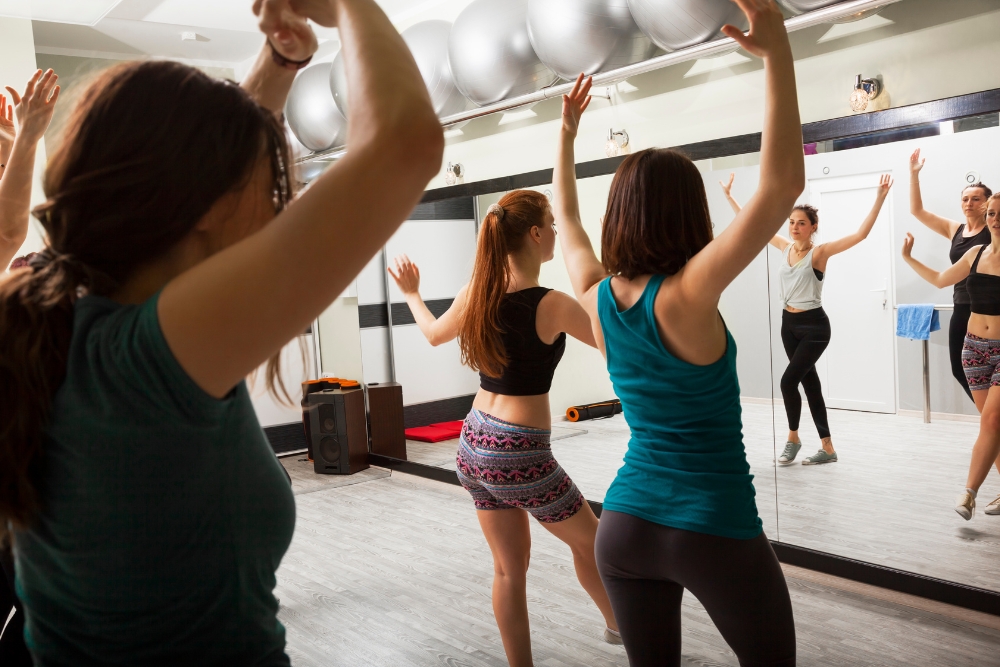
FlowFusion is a low-impact, dance-based movement class that blends flowing choreography, stretching and mindful movement. Rather than holding static poses, you keep moving.
For someone coming off a heavy session, that combination does a few useful things at once. You’re moving through full range without loading the muscles that copped it yesterday. You’re working on mobility, which most people who train hard neglect. And the pace is low enough that you’re not adding fatigue on top of fatigue.
It also feels like something. The trouble with a genuine rest day is that a lot of regular gym-goers hate them and end up doing a hard session anyway. A class that feels energising rather than draining is easier to stick to than an instruction to sit still.
Where it goes in a week built around the hard classes
The principle is simple: put FlowFusion 24 to 48 hours after your heaviest session, because that’s when soreness peaks.
Active Pump is the usual culprit for soreness, since high-rep resistance work involves a lot of slow lowering, and that kind of loading is the main driver of DOMS. If Pump is the hardest thing you do, build the rest of your week around it.
Boxing loads the shoulders and hips through a lot of rotation, so the day after tends to feel tight through the upper back rather than sore in the legs. A flowing full-body class the following day suits that well.
Active Circuit sits somewhere in between and depends on what was programmed that day.
What this looks like in practice is alternating: a hard class, then an easy day, then a hard class. Something like a hard session Monday, FlowFusion Tuesday, hard session Wednesday, FlowFusion or a full rest day Thursday, hard session Friday, and the weekend genuinely off. Adjust it to whatever is on the current group fitness timetable, and book through the MyClub Fitness app.
How to do the class as recovery, not as another workout
This is where people get it wrong.
If you attack FlowFusion the way you’d attack a circuit, you’ve just added a fourth hard session and defeated the purpose. A recovery session should leave you feeling looser than when you walked in.
A few things that help:
- Work at a level where you could hold a conversation
- Back off in any movement that pulls on the area that is sore, rather than pushing into it
- Treat the mobility work as the point of the session, not the warm-up to it
- Let it be shorter or easier than your normal training, because that is the whole idea
- Tell the instructor you’re using it as a recovery session so they can offer you options
You still need real rest days
Active recovery does not replace rest, and anyone telling you otherwise is selling something.
Movement between hard sessions helps with stiffness and helps you turn up to the next class feeling better. It doesn’t remove the need for days where you do nothing much at all. Most people training several times a week should keep at least one properly easy day, and often two.
If you’re still wrecked three days after a session, that’s information. The answer is to train less for a bit, not to add another class. And if what you’re feeling is sharp, localised or joint pain rather than general muscle soreness, that’s worth getting looked at by a physio or your GP rather than moving through.
For the broader picture on how rest fits around training, we’ve covered rest days and active rest techniques separately. General physical activity advice for adults is also available through Better Health Channel.
Giving it a go
If you’ve been training hard and treating recovery as whatever happens between sessions, one low-intensity class a week is a small change that tends to show up quickly in how your hard sessions feel.
Have a look at the FlowFusion class details, check when it’s running, and book yourself in for the day after your next big one.