
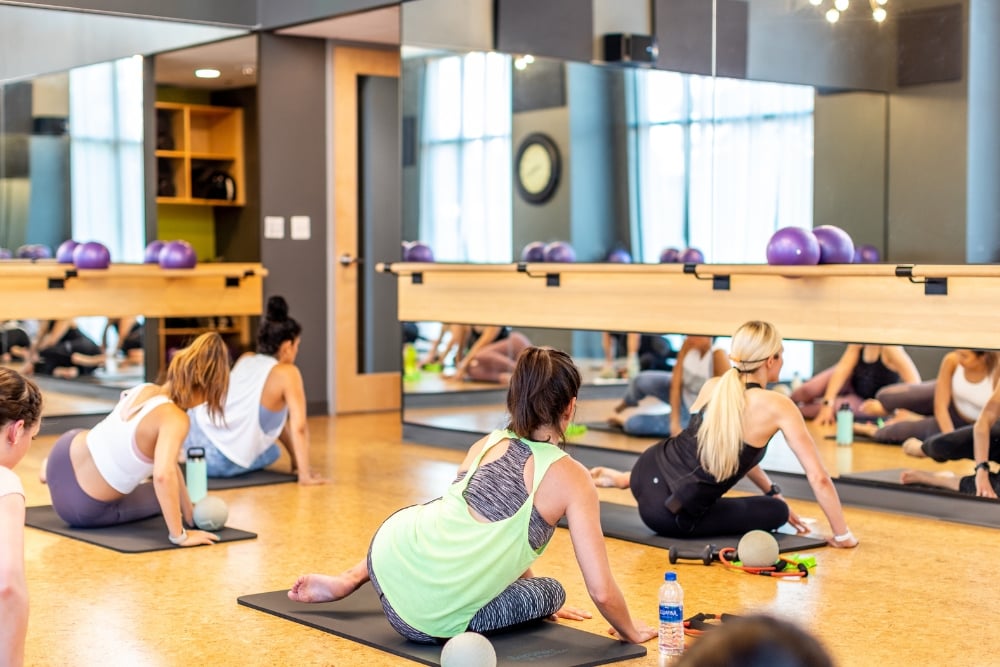
Barre builds core strength because you spend most of the class holding positions instead of moving through them. Holding a shape under load means your stabilising muscles never get a rest, and that sustained work is where deep core strength comes from.
Most people know barre for the ballet-inspired leg work and the glute burn. That part is real. The core side gets far less attention, which is a shame, because it’s arguably the more useful result.
What Core Strength Actually Means
Your core isn’t just your abs. It’s the group of muscles wrapping around your trunk: abdominals, obliques, the deep spinal muscles, your pelvic floor and your hip stabilisers. Together they hold your posture, steady your spine, pass force between your upper and lower body, and keep you upright when something knocks you sideways.
A strong core makes ordinary things easier. Lifting, running, sitting at a desk for eight hours, hauling a toddler onto your hip.
It matters for backs, too. About 8 in 10 people will get low back pain at some point that can’t be traced to a specific condition, and healthdirect’s guidance on low back pain lists weakness in the back and abdominal muscles, poor posture and long periods of sitting among the things that make it more likely. Strengthening and stretching work such as Pilates appears on their list of ways to help prevent it. Core strength won’t fix every sore back. It is one of the few factors you can actually do something about.
Why Barre Builds Core Strength So Effectively
1. You’re Holding Positions, Not Moving Through Them
A lot of barre uses isometric contraction, meaning you hold a shape under load instead of travelling through a full range of motion. Sink into a low, wide squat, hold it, then add small controlled pulses, and your stabilisers work continuously with no rest between reps.
Crunches and sit-ups train the big surface muscles. Isometric holds train the deep stabilisers that keep your spine and pelvis steady. Barre gives you a solid amount of both, which is unusual in a single class.
2. Single-Leg Work Keeps the Core Switched On
Barre leans heavily on single-leg exercises, arabesque positions, and lifting one leg while keeping everything else still. Balance on one leg for even a few seconds and your core fires in a way that two-legged exercises never ask for.
Your body has to micro-adjust constantly to stay stable, and those adjustments come from the deep core. Across a full class it adds up to a lot of unglamorous, useful work.
3. Alignment Cues Are Core Cues
Barre instructors cue alignment relentlessly. Lengthen the spine. Draw the navel in. Keep the pelvis neutral. Engage the pelvic floor.
Those aren’t just tidy-form reminders. Each one is a direct instruction to switch on a stabilising muscle. Repeat them across a whole class, then across a few months of classes, and your body starts holding the position without being told. That’s the point where it shows up in how you sit at your desk and how you move in everything else you train.
4. The Obliques Get Real Attention
Side waist work runs through most barre classes: lateral extensions, side bends, oblique curls. The obliques control rotation and side-to-side stability, and they’re routinely underdone in people whose ab training is all crunches.
Barre hits them from several angles. You end up with a core that works in every direction rather than one that only looks good from the front.
5. Small Range and High Reps Reach the Deep Muscles
That signature barre pulse, all tiny precise movements repeated dozens of times, exists to fatigue one specific muscle without letting momentum take over the job.
Strip out momentum and the stabilisers have nowhere to hide. It works particularly well on the transversus abdominis, the deepest of the abdominal muscles. It wraps around your midsection like a natural corset, it’s difficult to reach with big compound lifts, and it responds well to slow, controlled, repetitive work.
Barre or Pilates for Core Strength?
Fair question, and the honest answer is that they overlap more than they differ. Barre began as dance fitness, created by contemporary dancer Lotte Berk, and the method later absorbed elements of both yoga and Pilates. The core work in a barre class has Pilates fingerprints all over it.
The practical differences are worth knowing. Barre spends more time upright and standing, uses the barre itself for support, and runs at a higher repetition count. Mat Pilates spends more time on the floor, moves through fuller ranges, and puts the core at the centre of every exercise rather than treating it as a by-product of leg work.
If deep core strength is the main goal, Mat Pilates is the more direct route of the two. If it’s the dance feel you’re after, with flexibility alongside it, barre-style movement sits closer to a class like FlowFusion.
How Often, and Who This Style Suits
Twice a week is the usual starting point for low-impact core work, with a day in between. Once a week still helps. It just takes longer to show up.
Controlled, low-impact classes tend to suit people who want strength without jumping or heavy loading. That covers cranky knees, anyone easing back in after time off, pre-natal and post-natal members, and desk workers whose lower back starts complaining by Friday afternoon. If you’re pregnant, recently post-partum, or working around an injury, tell the instructor before class starts so they can modify. Any decent instructor will expect the question.
What You’ll Notice Over Time
Deep core strength is slow to build. Members who stick with low-impact core classes tend to report the same handful of changes after a month or two: posture feels easier to hold, the lower back feels better supported, and the core work in other classes stops being the hard part.
There’s no shortcut on this one. If you want that result without high-impact training, though, this style of class is one of the better ways to get there.

Low-Impact Core Classes in Medowie
Barre isn’t on our timetable. If core strength is what you’re chasing, Mat Pilates at Active Fitness Medowie is the closest match we run: low impact, deliberately small classes, and every exercise built around the core. It’s included with all gym memberships, excluding Fitness Passport.
Check the group fitness timetable for current class times, or call the team on (02) 4003 4868 and we’ll help you work out which class fits. No lock-in contracts, ever.